The Japanese train system
The railway system in Japan is so well developed, punctual, extensive and diverse that you can simply assume that wherever you plan to go – there is a train that will take you there.
The very first thing to know is that railway lines in Japan are not operated by a single company. National Japan Railways Group owns roughly 80% of the railroads, but the rest are privately owned companies.
Due to this, when reading the visual maps above any ticket-vending machine around Japan you will notice that some lines headed in the same direction have different prices. This is so because each company has its own price list.
You are free to select the company you wish. The Japan Rail Pass discounted multi-use ticket is part of the National JR Group.

Types of trains in Japan
Following are the intercity and suburban Japanese train categories explained:
Shinkansen (Super Express)
Also known as bullet trains, these are the fastest transportation modes in Japan with very few stops (if any) in comparison to the rapid or local ones.
The Shinkansen run on separate tracks and platforms since their track gauge is completely different from the others. This is due to the line’s high-speed capabilities and overall construction.
A Super Express fee is required when boarding any of the bullet trains, in addition to the regular base fee. The price is usually between 800 and 8,000 yen, depending on your final destination.
Note: Shinkansen bullet trains are included in the Japan Rail Pass*, which means that JR holders will not have to make any extra payments when boarding this train during the validity of their pass.
*With the exception of the “Nozomi and “Mizuho” privately owned trains.
Limited Express trains
There are over a 100 different types of Limited Express trains, with a limited number of stops, so they only go to major Japanese stations. Similar to the Shinkansen, the Limited Express also requires an additional fee to be paid. The Japan Rail Pass does cover some of those trains, however not all of them. The extra cost can vary between 400 and 4,000 yens.
Express trains
Many of the Japanese Express trains have been stopped and upgraded to Limited Express or downgraded to Rapid. The JR Group operates the current Express trains, which means Japan Rail Pass holders can use them free of charge. All other passengers will be charged an additional fee.
The JR Pass also covers the main airport transfers, which are usually operated by express or limited express trains: Haneda International Airport (Tokyo Monorail), Narita International Airport (Narita Express), and Kansai International Airport (Haruka Express).
Rapid trains
Passengers will not be charged any extra fees when boarding a rapid train. A single train ride costs equally to one local train ride. The only difference is that rapid trains skip a few stops in comparison to the local one, which makes their time of arrival notably shorter.
Local trains
To ride a local train you will need to buy a regular ticket. No extra fee will be required. Local trains can either go from point A to point B or run at loop lines both directions (like the Yamanote line in Tokyo or the Osaka loop line), stopping at all stations. It is recommended not to take these trains for long distances as they are some of the slowest and least spacious in Japan.
Special trains
While most trains are geared toward commuting or business travel, there are many trains that are designed for tourists. In Japan, this type of train is broadly referred to as joyful trains.
The most popular trains are the various steam trains that run on more scenic lines. These mostly run on weekends and holidays and many operate only in the summer months. Many of them called character trains have been given unique designs to attract visitors to scenic locations. This started with trains featuring characters popular with children, but more recently, prominent industrial designers have been recruited to design unique trains more appealing to adults.
Train tickets in Japan
Before explaining the ticket-buying process, let us focus on the train
The Japan Rail Pass

With the JR Pass, you can choose between 7, 14 and 21-day pass, giving you access to all Japan Railways Group (JR) trains, buses and ferry services available throughout Japan.
Standard train tickets
These are the regular tickets that will take you from point A to point B. For short distances, it is easier to purchase them from the ticket machines, which you can find easily on any platform.
IC cards
IC cards are prepaid rechargeable transportation cards, which can be used to pay your train or bus fare – similar to the London Oyster card, for example. Pasmo and Suica are the most popular transportation cards in Tokyo.
What is more, there is an increasing number of shops and restaurants where travelers can use an IC card to make a contactless payment.
Note: Please keep in mind that each Japanese city has its own prepaid travel card. The good news is that they are interchangeable, which means you can use your Tokyo Suica card on the Kyoto metro.
City passes
Many Japanese cities offer city passes that grant 24h unlimited access to any of the city transportation means such as trains, trams, buses, and metro. Such passes are also referred to as Day Pass. You can purchase them at a ticket counter in any of Japan’s big cities: Tokyo, Osaka, Kyoto, Sapporo, Nagoya, Hiroshima and more.
How to buy individual train tickets
Tickets for short distance trips are sold at vending machines, whereas tickets for long distance trips can be purchased at ticket counters.
First-timers might be puzzled by the typical Japanese ticket machines as grasping how to buy a ticket right from the beginning is not always easy. Do not be scared! Here is our step-by-step guide to managing the Japanese ticket vending machines:
How to use the ticket vending machines
- Locate the ticket vending area at your station. Typically there will be a big map above it.
- Take a look at the map and find the name of your final destination.
Tip: The station you are currently at will be written with larger letters (usually red) and in some occasions indicated by a red arrow (“You are here” style). The map displays the names of the stations in both Japanese and English together with the price to get to each destination. - Once you know how much your trip will cost you, take a look at the machine screen.
- Tap the “English” button on the top right corner of the screen for an English translation of the process.
- One the left hand-side of the screen select the number of passengers.
- If your final destination costs 200 ¥ (for example), select 200 on the screen (usually, you don’t choose the name of your destination but the price to get there).
- You can also insert coins/notes first. If you have added 200 (¥), the screen will highlight in green the options for this amount.
- Once you have selected the amount and inserted it, your ticket will be immediately printed and you will be given your change (if any).
- Even though it might seem complicated or too unfamiliar at first, don’t be discouraged. The second try will already be easier!Note: Keep your ticket with you until the end of your trip. You will need it to get out at your destination station.ain stations.
Where to store your luggage
Riding the trains with large suitcases is not recommended as there is little storage space provided on most trains. This excludes the Narita Express, which will take you to and from Narita Airport to central Tokyo, and the Haruka train. Both are well equipped for large luggage, however, the rest of the trains are not.Shinkansen trains offer overhead storage compartments for regular luggage. Also, there is space behind the last row of seats of each car. However, this space is limited, and there is no guarantee it will be available.The Japan Railways regulations state the following:- Each passenger can carry two pieces of large luggage.
- Each suitcase should not exceed 30 kg in total.
- The total of the luggage’s three dimensions (length, width, depth) should add up to 250 cm maximum. The length should not exceed 200 cm.
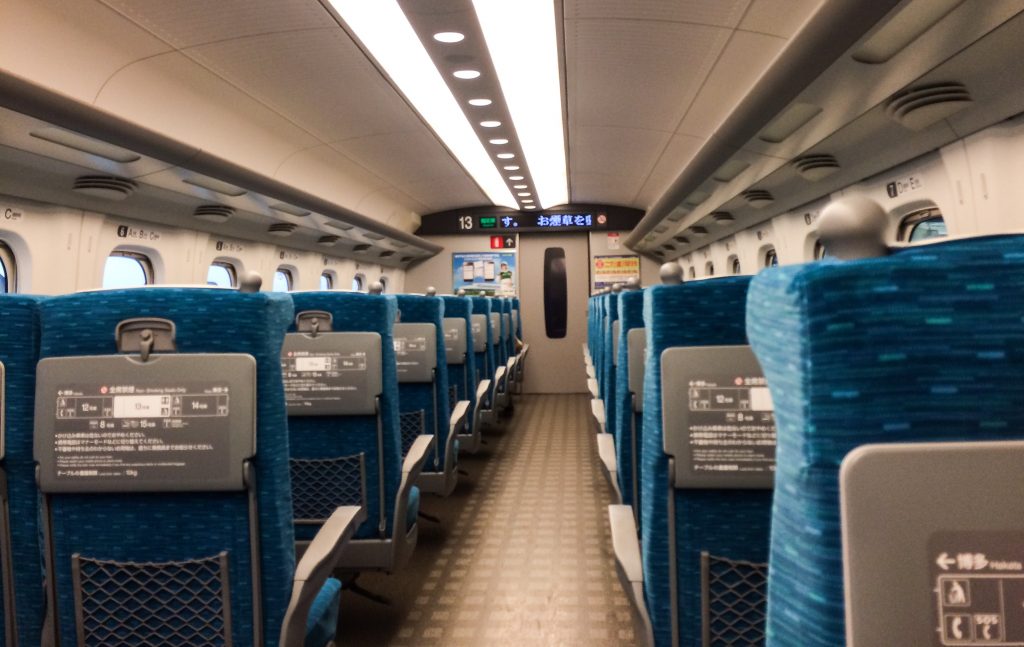
Interior of a Shinkansen bullet train Other travel tips
It is important to understand that the Japanese follow a strict etiquette in public and especially when riding a train or taking a bus. Always bear in mind that speaking on the phone is not accepted, as you are disturbing those who surround you.Listening to loud music, placing your bags on the seat next to you or not giving it up to the elderly, sick or pregnant is practically forbidden.A final recommendation will be to enjoy to the fullest your time in Japan but always to be mindful of those around you.
Comments
Post a Comment